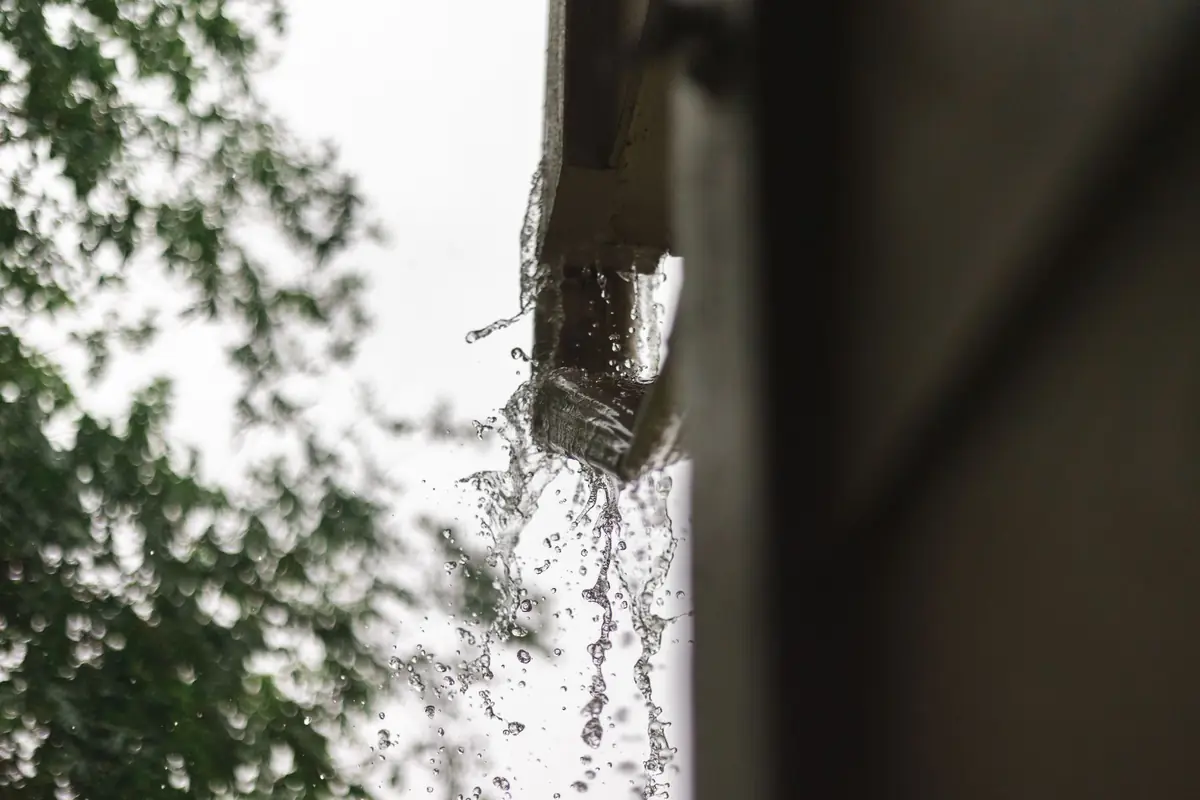
What overflow costs you
A gutter that overflows dumps water right where you least want it: against the foundation, onto walkways that ice over in winter and down the siding. In Warren, where most homes have basements, that water often shows up later as a damp basement wall or a wet corner near the floor drain. Overflow also soaks the fascia board behind the gutter, which leads to rot. See downspouts and basement water.
Cause 1: clogs
The most common cause is debris. Metro Detroit neighborhoods are full of mature maples, oaks and elms, and in spring the maple "helicopters" fill gutters as fast as fall leaves do. Clogs often form at the downspout opening, where debris piles up and blocks the outlet. Even a small clog at the top of the downspout can back up an entire run.
Fix: clean the gutters and flush the downspouts with a hose. If the downspout stays clogged, the blockage is often in the bottom elbow. See gutter cleaning and the fall leaves guide.
Cause 2: wrong pitch or sagging
Gutters need a slight slope toward the downspout, commonly about a quarter inch for every 10 feet. If the gutter is level, tilted the wrong way, or has sagged in the middle, water pools and spills. Winter ice adds weight and pulls hangers loose, so sagging often appears after a hard winter. See why gutters sag.
Fix: rehang the gutter with new hidden hangers at the correct slope.
Cause 3: not enough downspouts
A long run with one downspout at the far end can overflow even when clean. Each downspout can only drain so much water per minute. Long runs often need a downspout at each end, or one in the middle.
Fix: add a downspout or upsize existing ones from 2x3-inch to 3x4-inch. See downspouts and drainage.
Cause 4: gutters too small for the roof
Many older Warren homes have 5-inch K-style gutters. That is fine for small ranch roofs, but two-story homes, steep roofs and sections where two roof planes meet in a valley can push more water into one spot than a 5-inch gutter can carry. Summer thunderstorms in southeast Michigan can drop more than an inch of rain in an hour. The NWS Detroit/Pontiac office tracks these storms.
Fix: upgrade to 6-inch seamless gutters with larger downspouts, at least on the problem sections. See the gutter sizing guide and seamless gutters.
Cause 5: roof valleys and water shooting over
Where a roof valley empties into a gutter, water moves fast and can shoot right over the front edge. Steep roofs and metal roofs make this worse.
Fix: a valley splash guard, a short diverter at the corner, or a larger gutter at that spot.
Overflow in winter
In winter, overflow often means the gutter is full of ice. Meltwater from the roof has nowhere to go, so it runs over the front edge and forms icicles. That is a sign of an ice dam forming at the eaves, which is a roof and attic issue more than a gutter issue. See ice dams and heat cables and the ice dam guide.
Do gutter guards stop overflow?
Guards reduce clogs, but some guard types can cause overflow in very heavy rain because water sheets over the top of them. Fine-mesh guards and reverse-curve guards behave differently. See gutter guards and the gutter guard types guide.
Safety on ladders
Ladder falls cause many home injuries. Use a stable ladder on level ground, keep three points of contact, never lean out past the rails and have someone hold the ladder. Two-story gutters are a reasonable job to hand off.
When to call
- Overflow continues after cleaning.
- Gutters are sagging, pulling away or holding standing water.
- You want to add downspouts or upsize gutters.
- The fascia behind the gutter is soft.
Calls connect to independent gutter contractors serving Southwest Warren, North Warren, Center Line and Royal Oak.
If water is spilling over your gutters, ask for a written quote that lists the cause, gutter size, downspout changes and hanger spacing.
Finding the cause of an overflowing gutter
- Watch it in the rain From a safe spot on the ground, note exactly where water spills: one corner, the middle of a run or along the whole length.
- Check the downspout outlet Look for water coming out of the bottom of the downspout. A weak trickle during heavy rain means a clog in the downspout or elbow.
- Look for debris After the rain, use binoculars or a ladder with a helper to check for leaves, seed pods and shingle grit in the trough.
- Check the pitch Standing water in a gutter a day after rain means the slope is wrong or the gutter has sagged.
- Compare gutter size to roof Large or steep roof sections that dump into a single 5-inch gutter may simply need more capacity.
Related services
Questions homeowners ask
Why do my gutters overflow when they are clean?
Common causes are incorrect pitch, sagging, too few downspouts or gutters too small for the roof area feeding them.
How much slope should a gutter have?
A common guideline is about a quarter inch of drop for every 10 feet of gutter, toward the downspout.
Will bigger downspouts stop overflow?
Upsizing from 2x3-inch to 3x4-inch downspouts often helps on long runs or large roofs, as long as the gutters are clean and pitched correctly.
Why do my gutters overflow in winter?
Usually because ice fills the gutter and meltwater has nowhere to go. That is often a sign of an ice dam at the eaves.
General information for homeowners, not legal, insurance, health or other professional advice. Conditions in your home may differ; the provider who inspects it has the final word.